In this article7
- What actually differs from a landing page
- The mechanism most advertisers get wrong
- What to prepare before you spend a single riyal
- The cost: the ad budget is one thing, the conversation cost is another
- Honest measurement: four stages, not one number
- Three traps that cost you the campaign’s return
- The practical summary
The sentence that sums the whole article up: the ad does not sell, it opens a conversation — and the conversation is won or lost in the first thirty seconds after the click.
What actually differs from a landing page
A landing page asks the visitor to work: read, then fill in a form, then wait for a call they cannot time. And you get nothing until they press “submit”. If they leave at the third field, they leave without a trace.
An ad that opens a conversation inverts the order: the customer’s first act is to speak, not to fill something in. And when they speak you have a working WhatsApp number, the context of their question, and an open channel you can return to. Even a conversation that closed no deal today stays a contact in your database.
A click to a page, versus a click to a conversation
comparison| A click to a page | A click to a conversation | |
|---|---|---|
| The customer starts with one stepThe form asks for fields before offering any value | No | Yes |
| You get a way to reach them even if they do not finish | No | Yes |
| You can reply immediately, in the same momentA call depends on somebody being available | Partly | Yes |
| The customer knows who you are before they speakThe verified name appears at the head of the conversation | Partly | Yes |
| The context of the question is kept | No | Yes |
| You can follow up later at no extra costFree inside the window, and by template after it | No | Partly |
| Works without a connected WhatsApp number | Yes | No |
The mechanism most advertisers get wrong
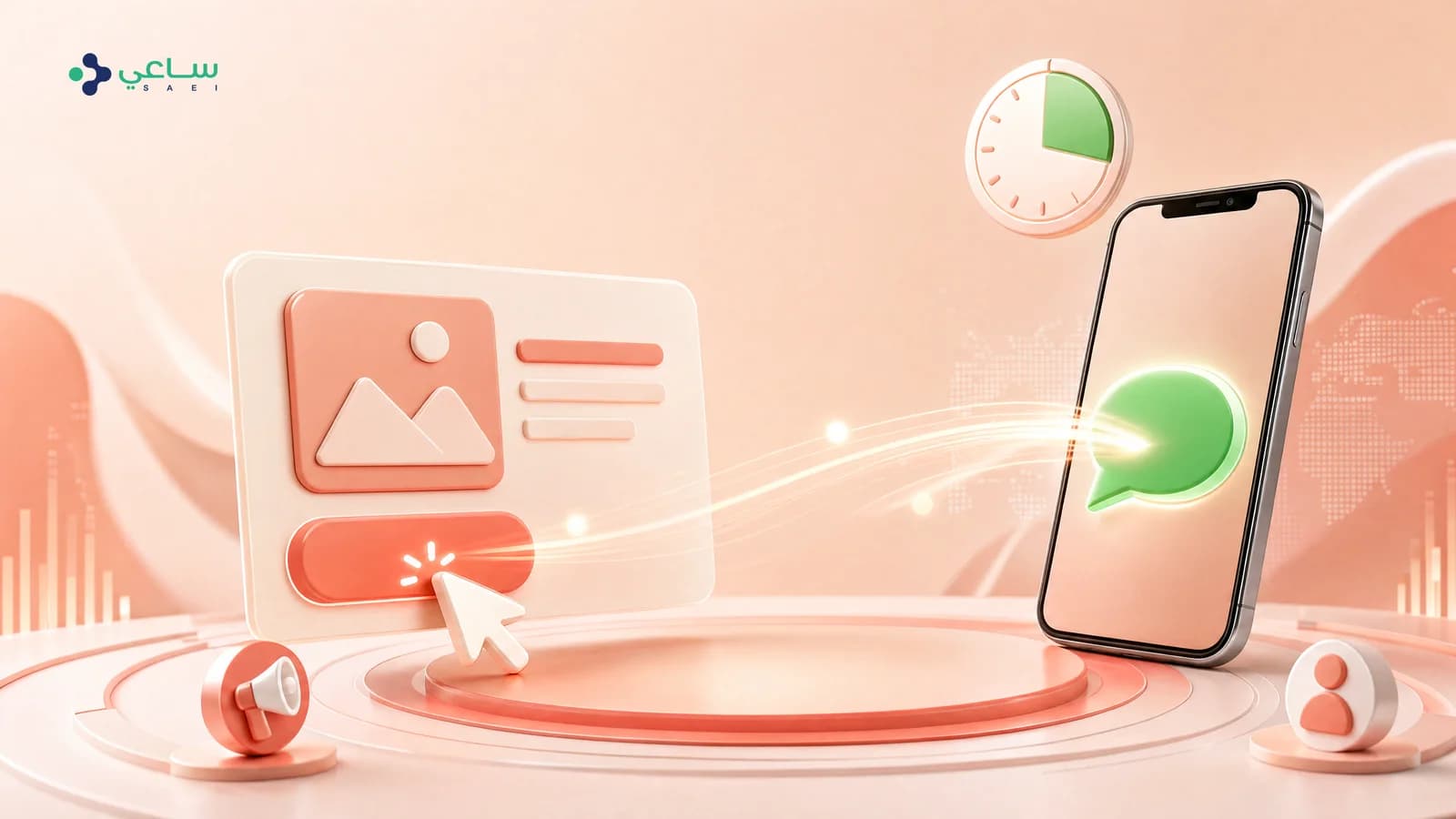
Clicking the ad does not open the 24-hour window. What happens is that the customer’s device opens a chat screen with your number, pre-filled with a ready message — and not one letter of it reaches you. The window starts at “send”, and only from that moment may you reply with free-form messages, and only then does the twenty-four-hour clock begin.
This explains two things that confuse everybody: that the click count in the ad report is always higher than the number of conversations in the inbox, and that a late reply is not merely a missed opportunity but the spending of a resource with a time limit on it.
From click to human: what actually happens
sequence- 1The click — nothing has reached you yetIt opens WhatsApp on a chat screen with your number, carrying a ready message you wrote in the ad. The customer can still leave without you knowing.
- 2Sending — this is where the window opensThe first message arrives, the contact and the conversation are created automatically, and the 24-hour clock starts, allowing you to reply freely with no approved template.
- 3An automatic reply within secondsA welcome flowIt receives, introduces your business in one line, and asks one question that sorts the enquiry — the type of service, or the city. One question, not a form.
- 4Sorting before it reaches a personThe customer’s answer puts a tag on the contact, so every enquiry ends up on the right path: pricing, booking, technical support. The agent opens the conversation already knowing why it is theirs.
- 5Handing over to a personThe bot stops at the first real request and hands the conversation to the team inbox, with a clear state, a named owner, anda tag saying what kind of enquiry it is. What is handed to nobody is never closed.
What to prepare before you spend a single riyal
An ad that works and a number that cannot receive is the worst possible combination: you are paying for clicks that end in silence. Sort these three first, and in this order.
- A number connected officially and ready to receive. It is not enough for the number to work on your phone; it has to be connected through Meta with a visible status and quality rating. And if you meet “this number is not eligible” when you try, that is a message from Meta with specific causes, which we set out in a separate guide — deal with it before you schedule the ad, not after.
- A welcome flow, built and tested. Inside the window you need no approved template, because free-form replies are available — but you do need a ready flow that knows what to say and when to stop. Test it in the simulator before you publish, not on the first customer your ad paid for.
- Who picks up after the bot. Name the people and the states: who opens new conversations, which state counts as “closed”, and what happens to a conversation that arrives at midnight. Without that definition the campaign becomes a waiting list.
The cost: the ad budget is one thing, the conversation cost is another
Confusing the two numbers is what most often ruins the return calculation. The campaign budget is paid to the ad platform for impressions and clicks, and has nothing to do with Meta’s message pricing. Messages follow an entirely different logic: your replies inside the 24-hour window are free, and cost only starts once the window closes and you want to start the conversation again with a template.
What 1,000 conversations from an ad cost you
cost| What you are sending | Meta’s category | Cost of 1,000 conversations |
|---|---|---|
| Your replies inside the 24-hour window | A reply to a customer | Free |
| A follow-up after the window closes, with a utility template | Utility | 40.10 SAR |
| The same follow-up with a marketing template | Marketing | 187.70 SAR |
| The ad budget itself | — | Paid to the ad platform, outside message pricing |
Read the table from the bottom up and you find the real equation: the team that replies in time pays nothing on messages, and the team that lets the window close and then chases the customer with a template pays 40.10 SAR at least — and if they pick the wrong category the figure becomes 187.70 SAR for the same volume. The whole difference comes down to minutes.
To work out your own numbers rather than this example, use the pricing calculator.
Honest measurement: four stages, not one number
The most misleading report in this kind of campaign is the one that stops at clicks. A click is not a conversation, and a conversation is not a qualified lead. There are four stages, and each is measured in a different place:
| Stage | What it means | Who sees it |
|---|---|---|
| Click | A chat screen opens on the customer’s device — nothing has reached you yet | The ad platform alone |
| Conversation started | The first message arrived and the window opened | Your inbox, which is the record |
| A qualified lead | They answered the sorting question and what they want is something you offer | The tag inside the platform |
| A deal | They paid, booked or signed | Your own system, recorded by hand on the contact |
The ad platform knows the click, and may know a conversation started. It does not and will not know who was qualified and who bought — that information is born inside your inbox, and never reaches the report unless somebody tags it. Which is why tagging is not extra administration; it is the only link between what you spent and what you earned.
Three traps that cost you the campaign’s return
- Sending a marketing template inside a window the ad opened. The customer asked about a price and received the seasonal offer. You paid for a message that a free-form reply would have covered for nothing, and opened the door to a “spam” report that hits your number’s quality rating — and the quality rating is what governs your daily sending limit.
- A slow reply. The campaign runs around the clock and the team works eight hours. Every conversation that arrives out of hours with no automatic reply is a window spent in silence, and a customer who wakes up in the morning having bought from somebody else.
- Routing everything to one person. A number that ends at one colleague’s phone works painlessly at five conversations a day, then collapses on the first successful campaign. Worse, the collapse is silent: nobody sees the conversations that went unanswered. The fix is not a faster colleague but a shared inbox, with states and an owner for every conversation.
The practical summary
- The click does not open the window — the customer’s first message is what opens it, and the 24-hour clock starts there.
- Inside the window you reply with no approved template and no message cost. This is the cheapest and fastest moment in the whole relationship — use it.
- The first reply is automatic and within seconds, and its only job is to receive and sort, then hand over to a person.
- Read your campaign as four stages rather than clicks alone, and tag every conversation so the report knows what the ad platform does not.
- Before you spend: a connected number, a tested flow, and a team that knows who picks up. All three, or do not launch.
Does clicking the ad open the 24-hour window?
No. The click opens a chat screen pre-filled with a ready message on the customer’s device only, and nothing reaches you from it. The window starts the moment the customer actually presses “send”, and the clock begins there. This is why the click count in your ad report is always higher than the number of conversations in your inbox — it is not a measurement fault.
Do I need a Meta-approved template to reply to somebody who came from the ad?
No, as long as you are inside the 24-hour window. The customer started the conversation, so you may reply with free-form messages: text, images, buttons, lists — no review and no waiting for approval. An approved template only becomes necessary once the window closes and you want to start the conversation again.
What does a conversation from the ad cost me?
The ad budget is paid to the ad platform and has nothing to do with message pricing. As for the messages themselves, your replies inside the 24-hour window have been free at Meta since November 2024. A cost only appears if the window closes and you need a template to reopen the conversation, and then it is charged per message according to the template’s category — the table in this article shows the difference in riyals.
Why is sending a marketing template inside an open window a mistake?
For two reasons. First, you are paying for a message that could have been sent for nothing, because a free-form reply was available to you inside the window anyway. Second, the customer arrived with a specific question and received a promotional offer unrelated to it — the fastest route to a “spam” report, which hits your number’s quality rating and shrinks your daily sending limit.
What is the minimum speed I should reply at?
The first reply should be automatic and within seconds, because the customer is still looking at the screen. The practical difference is that somebody who finds an instant reply carries on, and somebody who waits ten minutes has opened another ad. That does not mean the bot closes the sale — it is enough that it receives, asks one question that sorts the enquiry, and holds the customer until a person picks it up.
What do I do if the ad brings customers outside working hours?
That is the best case for running a full automatic flow: it receives, collects what you need (the type of enquiry, the city, the budget), and tells the customer honestly when a human reply will arrive. The conversation stays open and waits for you in the inbox in the morning. The mistake is complete silence: the 24-hour window will have been spent before anybody opens their laptop.